


Understanding Glare — And How MidOpt Polarizers Help Eliminate It
Light and color — whether in photography, quality inspection, or everyday vision — look their best when surfaces are clear, textures are visible, and colors are natural. But often, shiny or smooth surfaces spoil this by producing unwanted glare: bright reflections, washed-out colors, or “hot spots.” In many applications — from product imaging and machine vision to photography of glass, plastic, or metal surfaces — glare is a persistent nuisance.
Fortunately, thanks to physics and smart optical design, glare can be controlled — using polarizing filters. In particular, MidOpt’s polarizing solutions bring polarization theory into practical, industrial-grade imaging setups. In this post, we dive into why glare happens, what polarization does, and how MidOpt polarizers and polarizing films can be used to produce clear, glare-free, high-contrast images.
Diffuse vs Specular Reflection
When light strikes a surface, there are two main ways it can bounce:
Surfaces like water, glass, glossy plastic, varnished wood, metal, or even wet grease/oil are especially prone to specular reflection. That’s why they exhibit strong glare under direct lighting.
How Polarization Enters the Picture
Light is an electromagnetic wave. In unpolarized light (like sunlight or typical artificial light), the electric field oscillates in all possible perpendicular directions.
However, when unpolarized light reflects off a non-metallic smooth surface (dielectric surfaces such as glass, water, plastic, etc.), the reflected component tends to become partially polarized.
At a special angle — Brewster’s angle — the reflected light can be almost completely polarized.
Thus, the glare we see from such surfaces is not just bright: it’s often polarized light. If we can filter out light of that polarization, we can suppress or eliminate glare — leaving only diffuse reflection (which carries true color, texture, and surface detail).
This is where polarizing filters come in.
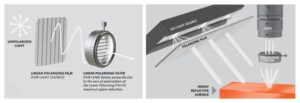
A polarizer is an optical filter that only allows light vibrating in a specific plane to pass through, rejecting (absorbing or reflecting) the rest. (Wikipedia)
When done correctly, this reduces or eliminates “hot spots,” reveals hidden textures, improves contrast, and restores true colors.
An additional technique — cross-polarization — makes this even more effective.
3. Cross-Polarization: Maximizing Glare Suppression
Cross-polarization involves using two polarizers:
1.A polarizing filter (or film) on the light source — so that the illumination itself becomes polarized.
2.A polarizing filter on the camera lens — oriented perpendicular (90°) to the light-source polarizer.
When the light hits a smooth surface and reflects, the reflected light retains the polarization from the light source (for specular reflection). Because the lens’s polarizer is perpendicular, it blocks most of that reflected light — effectively eliminating glare. What remains is predominantly diffuse reflection — giving a clean, glare-free image with accurate color and visible surface detail.
Cross-polarization is widely used in product photography, 3D scanning, medical imaging (e.g. skin, nail photography), and machine vision — anywhere reflections from shiny or transparent surfaces interfere with accurate imaging.
However: since polarizers block a portion of the light, total light intensity reaching the sensor is reduced — so exposure (shutter speed, aperture, ISO) may need adjustment.
4. MidOpt Polarizers & Films: Bringing Polarization to Real-World Imaging
This is where MidOpt’s products shine. Their polarizing filters and polarizing films are designed specifically to tackle specular glare, improve contrast and color saturation, and even reveal imperfections in transparent materials — making them ideal for photography, quality inspection, machine vision and more. (MidOpt)
What MidOpt Offers
MidOpt emphasizes that optimal glare reduction is achieved when a linear polarizer is oriented to pass only light polarized perpendicular to the reflected light (the glare). (MidOpt)
In many example applications — imaging of PCBs under flux, clear plastic packaging, curved bottles, transparent media, oily or glossy surfaces — using a MidOpt lens polarizer combined with a polarizing film over the light source dramatically reduces specular reflections, restores color, improves contrast, and reveals hidden details. (MidOpt)
In short: MidOpt brings polarization not as a theoretical trick but as a practical, reliable tool for real-world imaging tasks.
5. Real-World Use Cases: Where Polarization + MidOpt Makes a Big Difference
Here are some typical scenarios where using MidOpt polarizers (and films) can vastly improve results:

Here’s a practical guide for a typical imaging setup:
1.Select the right polarizer for the lens
2.Polarize your light source
3.Rotate and align the lens polarizer
4.Set exposure / camera parameters carefully
5.For best results: cross-polarization setup
Polarizers are powerful — but they’re not magic. Some caveats:
Glare — that bright, mirror-like reflection from water, glass, plastic, glossy or wet surfaces — is more than an aesthetic nuisance. It conceals texture, color, and detail — often obscuring the very thing you want to see.
Understanding the physics behind reflection and polarization opens the door to controlling glare. By using polarizing filters and films, specifically through a cross-polarization setup, you can suppress unwanted reflections, restore accurate color and contrast, and reveal textures and details otherwise hidden.
With solutions from MidOpt — quality lens polarizers (linear, circular, or infrared) and polarizing films for light sources — you have a professional-grade toolset to handle glare in photography, quality inspection, microscopy, machine vision, product photography, or any application involving shiny or transparent surfaces.
Disclaimer: This blog includes information compiled from publicly available sources and AI tools, provided for general informational purposes only. Accuracy is not guaranteed—readers should independently verify all facts before relying on the content. All trademarks, images, and referenced materials belong to their respective owners and are used only for informational or educational purposes. No copyright infringement is intended.
Whether you’re capturing product images, inspecting PCBs under bright lights, photographing glass or plastic components, or doing precise visual inspection — polarization might just be the missing piece that makes your images clean, accurate, and glare-free.
We'll be glad to help you! Please contact our Sales Team for more information.
We'll be glad to help you! Please contact our Sales Team for more information.