
Machine Vision Course – Engineering Decisions in Designing a Vision System
25 June 2026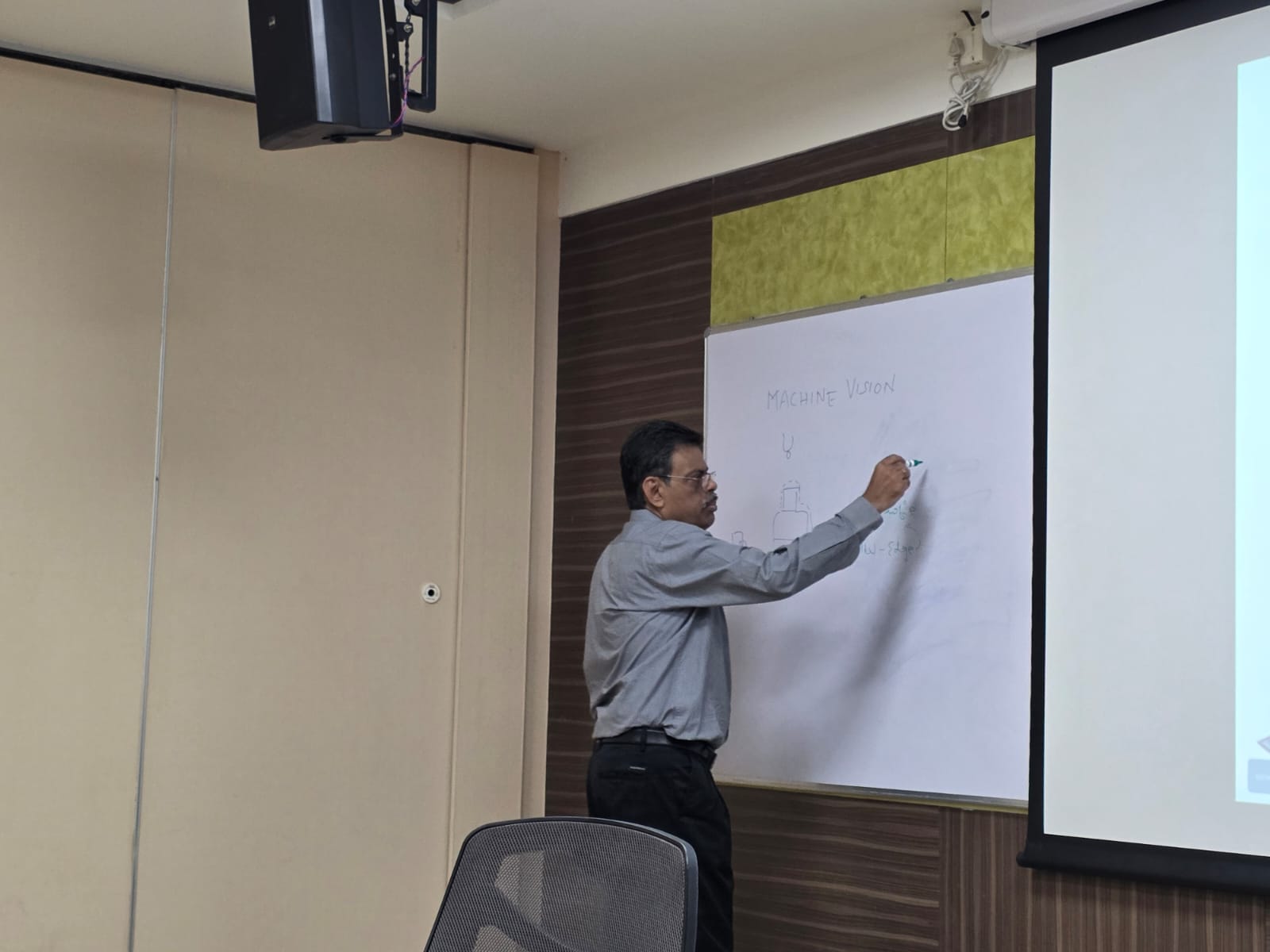
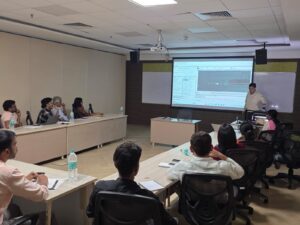
Rather than introducing individual hardware components in isolation, this course guided participants through the engineering thought process involved in designing a complete Machine Vision solution. Each module built upon the previous one, enabling attendees to understand not only what components are available, but more importantly why they are selected and how they influence the final inspection system.
1. Understanding the Inspection Problem
The course began by helping participants understand what Machine Vision is and where it fits into industrial automation. Before discussing cameras or software, emphasis was placed on analysing the inspection requirement itself. Participants learnt how to study the product, identify the features or defects to be inspected, define measurement accuracy, understand production speeds and evaluate environmental constraints. This established the principle that successful machine vision projects always begin with a thorough understanding of the application rather than with hardware selection.
2. Engineering the Image
Once the application was understood, the course focused on creating an image that contains the information necessary for reliable inspection.
Participants learnt how to select the appropriate camera technology by understanding image sensors, resolution, pixel size, frame rate, exposure, spectral response and shuttermechanisms. The differences between CCD and CMOS technologies, monochrome and colour imaging, as well as Area Scan and Line Scan cameras were explained with their typical industrial applications.
The course then introduced industrial optics, explaining how focal length, working distance, aperture and sensor size influence the field of view and image quality. Special emphasis was given to Telecentric Lenses for precision dimensional measurement and Liquid Lenses for high-speed autofocus applications.
Lighting was presented as perhaps the most influential factor in machine vision. Participants learnt how different lighting geometries—including ring lights, bar lights, dome lights, backlights and coaxial illumination—can either reveal or suppress specific features. The importance of wavelength selection, bright-field versus dark-field illumination, and the use of optical filters and polarizers was also discussed.
By the end of this module, participants understood that image quality is engineered through the correct combination of camera, lens and lighting long before any software processing begins.
3. Moving Images from Camera to Computer
With image acquisition established, the course introduced the technologies used to transfer image data to the processing system.
Participants were familiarised with industrial camera interfaces such as GigE Vision, USB, Camera Link, IEEE1394, CoaXPress and other high-speed communication standards. The role of frame grabbers, PCIe interfaces and synchronization signals was explained, particularly for high-speed and Line Scan imaging systems.
Special attention was given to Line Scan imaging, where participants learnt how continuous images are constructed one line at a time and why encoder-based synchronization is essential for accurate inspection of moving products.
4. Converting Images into Engineering Information
Having understood image formation, the course moved into image processing and analysis.
Participants learnt the sequence of image preprocessing, feature extraction and decision making. The session introduced commonly used machine vision tools such as Blob Analysis, Pattern Matching, Edge Detection, Caliper Measurement, OCR, Barcode Reading, Colour Analysis and Object Tracking. Rather than focusing on algorithmic complexity, the emphasiswas placed on selecting the right analytical technique for a given industrial inspection problem.
The role of software—including camera drivers, SDKs, graphical development environments and embedded vision software—was also explained, showing how software integrates the various hardware components into a complete machine vision solution.
5. Selecting the Appropriate Vision Architecture
The course then broadened the discussion to complete system architectures.
Participants were introduced to Vision Sensors, Smart Cameras and conventional PC-based Machine Vision systems. The advantages, limitations and typical applications of each architecture were discussed, enabling participants to appreciate when a compact standalone smart camera is sufficient and when a high-performance PC-based system is necessary.
6. Looking Beyond Conventional Machine Vision
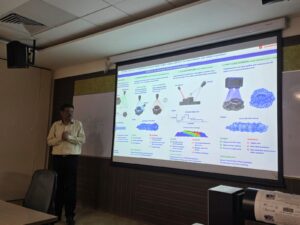
While conventional machine vision relies on visible light imaging, the course expanded the participants’ perspective by introducing a range of advanced sensing and imaging technologies used across industrial inspection, defence, security, medical and scientific applications.
Participants were introduced to the principles of 3D Machine Vision, where laser triangulation techniques are used to generate depth information for accurate dimensional measurement, profiling and volume estimation. The course explained how laser wavelength selection, camera geometry and calibration influence measurement accuracy in industrial 3D profiling systems.
The programme then moved beyond traditional visible-light imaging to provide an overview of multi-spectral and hyper-spectral imaging, demonstrating how analysing reflected energy across different wavelengths enables the detection of material composition, contamination, moisture content and defects that are invisible to the human eye. Through practical examples, participants appreciated how spectral imaging is increasingly being adopted in agriculture, food processing, pharmaceuticals, semiconductor inspection and waste segregation.
The course further introduced X-ray imaging as a complementary inspection technology capable of revealing internal structures and hidden defects without damaging the object. Participants gained an understanding of its application in electronics, battery inspection, baggage screening, castings and quality assurance where conventional optical imaging is insufficient.
Emerging technologies such as Terahertz (THz) imaging were also presented, illustrating how they enable non-contact inspection beneath non-metallic materials and are finding applications in aerospace composites, advanced materials, semiconductor packaging and security screening.
To broaden the participants’ appreciation of real-world deployments, the session also showcased specialised vision applications including Under Vehicle Inspection Systems (UVIS) for security screening, drone-based vision systems for aerial inspection and surveillance, and other application-specific imaging platforms. These examples demonstrated how imaging technologies are adapted to solve problems across diverse industries, extending far beyond conventional factory automation.
Collectively, this module helped participants recognise that successful inspection is not limited to selecting a camera, but to selecting the most appropriate sensing technology based on the physical characteristics of the object, the information required and the operational environment.
- Emerging Intelligence in Vision Systems
The programme also introduced Artificial Intelligence and Deep Learning as the next stage in the evolution of industrial vision. Participants gained an appreciation of how AI complements traditional rule-based image processing by enabling robust classification, anomaly detection and defect recognition in applications where handcrafted algorithms may be difficult to develop. This provided attendees with an understanding of the direction in which modern industrial inspection systems are evolving.
Course Outcome
By the end of the programme, participants had acquired a structured methodology for designing industrial Machine Vision systems. Rather than viewing cameras, lenses, lighting, interfaces and software as independent technologies, they learnt how these elements work together to form a complete inspection solution. More importantly, they developed the ability to translate an application’s inspection requirements into informed engineering decisions regarding image acquisition, system architecture, image analysis and deployment.
By Online Solutions (Imaging) Pvt Ltd., Chennai 12th and 13th June 2026
Recent Posts

Get the latest updates from ONLSOL directly in your inbox
We'll be glad to help you! Please contact our Sales Team for more information.
Would you like to learn more about Product Details?
Chat with Sales TeamWe'll be glad to help you! Please contact our Sales Team for more information.

Have an Imaging Challenge?
Tell us what you need to see, measure, identify, inspect or analyse.
Let's engineer the imaging approach.