

High-speed inspection and precision separation for improved grain quality and purity
| APPLICATION Optical sorting of grains and seeds |
IMAGING Line-scan sensing or line-scan cameras |
CONTROL Real-time image processing and timed ejection |
Application Overview
Imaging-based grain sorting inspects individual kernels as they move at high speed through a controlled imaging zone. The system captures each grain, evaluates visible or spectral characteristics, classifies it against configured quality criteria and triggers a physical separation mechanism for grains marked for rejection. The same overall concept can be adapted to different grains and seeds, with the illumination, optics, image features and classification rules tuned to the crop and the required grading standard.
The Imaging Concept
A line-scan sensor can acquire successive rows of image data as grains move past the inspection point. With a suitable optical arrangement, controlled lighting and synchronized motion, those rows form a continuous image of the material flow. A multi-line sensor can provide separate colour channels and, where supported by the sensor configuration, an additional spectral channel such as near-infrared. This can help distinguish kernels by colour and surface appearance and may reveal differences not obvious in a conventional colour image.
A line-scan camera is an alternative to building a system around a bare line sensor. It packages the sensor with camera electronics and a standard image interface, potentially simplifying integration and maintenance. The choice depends on required spectral channels, line rate, resolution, data interface, processing architecture, cost and the intended throughput.
Illustrated Process Flow
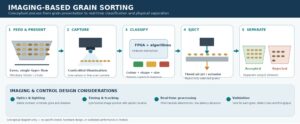
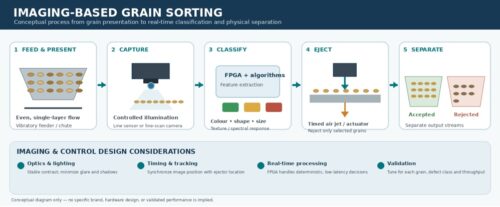
Original conceptual diagram. It does not depict a specific manufacturer’s product or a validated production system.
Typical Sorting Criteria
Not every defect can be identified from visible imaging alone. Internal contamination, hidden damage or classes with very similar appearance may require additional spectral bands, other sensing methods, sample preparation or a separate inspection step.
Real-Time Processing and FPGA Control
High-throughput sorting requires image acquisition, feature extraction, classification and ejection timing to operate within a predictable time budget. An FPGA-based processing platform can support deterministic, parallel processing of image streams and rapid control signals. Depending on the design, an embedded processor or host computer may handle configuration, recipes, logging and the user interface, while time-critical processing and control are implemented in programmable logic.
The processing pipeline may include image correction, segmentation of individual kernels, measurement of features such as colour, area, shape and texture, classification against a selected recipe, and generation of a reject decision. Each decision must remain associated with the corresponding grain as it travels from the imaging zone to the ejector.
Ejection and Material Separation
After classification, the system estimates when each selected grain will reach the ejection point. An encoder or other motion reference can help track material movement and compensate for changes in conveyor or chute speed. A bank of fast pneumatic air jets is commonly used to deflect rejected grains into a separate chute; mechanical actuators or other separation mechanisms may be appropriate for different machine layouts. Precise timing and nozzle alignment are essential: an early or late pulse can eject a good kernel or allow a defective one to pass.
The accepted stream continues to the product outlet, while rejected grains and detected foreign material are collected separately. Multiple outlets or sorting passes can be used where the application requires more than one quality grade.
Lighting, Calibration and Mechanical Design
Benefits of the Imaging-Based Approach
Important Design and Validation Considerations
This is a conceptual application case study, not a report of a completed installation. Sorting accuracy, throughput, false-reject rate, missed-defect rate and grain loss depend on the grain type, defect definitions, sensor and optics, illumination, material presentation, algorithm, ejector geometry and calibration. These figures should be established through trials using representative samples at the target production rate. Food-safety and quality requirements should also be included in system validation.
Disclaimer
This document describes a general imaging and automation concept. It is not a specification for a particular machine, a claim of validated performance or a recommendation of any specific sensor, camera, FPGA or ejector product. The diagram is illustrative. The final system architecture and performance must be established by engineering design, sample testing and validation under actual operating conditions.
We'll be glad to help you! Please contact our Sales Team for more information.
We'll be glad to help you! Please contact our Sales Team for more information.